Here’s what no one tells your husband about Korean men’s hair: the secret isn’t expensive shampoo — it’s that Korean men treat their scalp like skincare, and they start in their 30s, not after the damage shows at 45. You’ve watched enough K-dramas to notice it. The male leads — even the ones playing men in their 40s and 50s — have thick, healthy hair that looks effortless. Meanwhile, the man in your life is using the same 2-in-1 bottle he’s grabbed since college and wondering why his hair is thinning. These 7 Korean hair care rules take under 5 minutes a day, require zero convincing about “beauty routines,” and target the one thing Western men’s grooming completely ignores: the scalp.
Quick-Pick Summary: 7 Korean Hair Rules at a Glance
| Rule | What It Is | Time | Difficulty | Impact |
|---|---|---|---|---|
| #1 Scalp First Philosophy | Treat scalp like face skin | 0 min (mindset) | Easy | ★★★★★ |
| #2 Weekly Scalp Scaling | Exfoliate buildup at the root | 3 min/week | Easy | ★★★★☆ |
| #3 한방 Herbal Shampoo | Switch to Korean herbal formula | 0 extra min | Easy | ★★★★☆ |
| #4 Scalp Tonic on Damp Hair | Feed the scalp post-wash | 30 sec | Easy | ★★★★☆ |
| #5 Cool Water Final Rinse | Seal cuticles, calm scalp | 15 sec | Easy | ★★★☆☆ |
| #6 Eat for Your Hair | 미역국, black beans, sesame | Part of meals | Medium | ★★★★★ |
| #7 2-Minute Scalp Massage | Nightly circulation boost | 2 min | Easy | ★★★★☆ |
1. The Korean Hair Care Rule That Changes Everything: Scalp First, Hair Second
In Korea, hair care starts at the scalp — not at the ends. This is the single biggest difference between how Korean men and Western men approach their hair. Walk into any Korean drugstore and you’ll see an entire aisle dedicated to 두피 관리 (dupi gwanli, scalp management) — products your husband has never heard of because Western brands barely acknowledge the scalp exists.
The logic is simple and hard to argue with: hair grows from the scalp. If the scalp is clogged, inflamed, or dry, the hair that grows out of it will be weak, thin, and prone to falling out. Korean men understand this the way Korean women understand double cleansing — it’s foundational, not optional.
According to dermatological research, scalp health directly influences the hair growth cycle, and conditions like seborrheic dermatitis and follicular inflammation are linked to increased hair shedding. Korean grooming culture absorbed this science decades ago. Western men’s grooming is still stuck on “just use conditioner.”
Tell the man in your life: if he does nothing else on this list, just shifting his thinking from “hair product” to “scalp care” will change his results within a month.
2. Weekly Scalp Scaling: The Korean Barbershop Step Nobody Exports
Korean barbershops include a scalp scaling treatment as standard — not as an upsell, but because skipping it would be like a dentist skipping the cleaning. Scalp scaling removes the layer of sebum, dead skin cells, product residue, and micro-debris that shampoo alone cannot dissolve. In Korea, men get this done professionally every 2-4 weeks, and they do a lighter version at home weekly.
Here’s what your husband is missing without it: that buildup gradually suffocates hair follicles. The hair doesn’t fall out dramatically — it just gets thinner, finer, and weaker over months. By the time he notices “thinning,” the scalp has been clogged for years.
The at-home version takes 3 minutes in the shower. Apply a scalp scaler (a gel or salt-based exfoliant designed for the scalp, not a face scrub) to wet hair, massage in small circles with fingertips — never nails — and rinse thoroughly before shampooing. Once a week is enough.
Most Korean men start this in their late 20s. For a man over 40 who’s never scaled his scalp, the first session alone can remove months of invisible buildup. He’ll feel the difference immediately — lighter, cleaner, like his scalp can finally breathe.
Ryo Scalp Deep Cleansing Scaler
This is what Korean barbershops actually stock. The 려 (Ryo) scaler uses green tea and ginseng extracts to dissolve buildup without stripping — your husband will feel the difference after one use.
(paid link) Check Availability & Reviews →
3. Switch to 한방 Herbal Shampoo: What Korean Men’s Hair Care Gets Right About Ingredients
The most popular men’s shampoo category in Korea isn’t “volumizing” or “sport” — it’s 한방 (hanbang), which means traditional Korean herbal medicine. 한방 (hanbang, Korean herbal medicine) shampoos contain ingredients like ginseng root, 녹두 (nokdu, mung bean), licorice extract, and he shou wu (Polygonum multiflorum), herbs that have been used in East Asian hair treatments for centuries.
The difference matters after 40 because Western shampoos are formulated primarily for cleaning. Korean 한방 shampoos are formulated for scalp environment — balancing oil production, calming irritation, and supporting the follicle cycle. The active herbal compounds work with your scalp’s biology instead of stripping it bare and hoping conditioner fixes the damage.
Ryo (려), made by Amorepacific, is the most recognized 한방 hair brand in Korea — you’ll find it in virtually every Korean household. Their anti-hair-loss line is specifically formulated around ginseng and green tea to strengthen roots. It smells herbal and clean, not perfumy, which matters for men who refuse anything that smells “like a spa.”
The swap takes zero extra time. Same shower, same routine — just a different bottle. That’s the kind of change even the most resistant husband will agree to.
Ryo Jayangyunmo Hair Loss Care Shampoo
Korea’s bestselling anti-hair-loss shampoo, powered by ginseng and herbal extracts. This is the bottle sitting in most Korean men’s showers — not because of marketing, but because their wives put it there and it worked.
(paid link) See Why Reviewers Love This →
4. Scalp Tonic on Damp Hair: The 30-Second Korean Hair Care Step With Outsized Results
Korean men apply scalp tonic the way Western men apply aftershave — it’s not optional, it’s the finishing step that makes everything else work. A scalp tonic (두피 토닉, dupi tonik) is a lightweight, fast-absorbing liquid you apply directly to the scalp after towel-drying. It delivers concentrated active ingredients — usually niacinamide, caffeine, biotin, or herbal extracts — straight to the follicle while pores are still open from washing.
Think of it this way: your husband wouldn’t wash his face and skip moisturizer. But that’s exactly what he’s doing to his scalp every single day. The tonic replaces what shampoo removed, nourishes the roots, and creates an environment where hair can actually grow thicker.
Application takes 30 seconds. Part the hair in 4-5 sections, apply the tonic directly to the scalp line, and massage briefly with fingertips. Done. No blow-drying required, no waiting, no extra mirror time. Most tonics dry invisible within a minute.
Here’s the loss-aversion reality: without post-wash scalp nutrition, every shower is a net loss for his follicles — he’s cleaning but never replenishing. Korean men figured out this imbalance years ago.
5. The Cool Water Final Rinse: A Korean Hair Care Trick From 찜질방 Culture
Every Korean man who grew up going to 찜질방 (jjimjilbang, Korean bathhouses) learned this instinctively: you always end with cool water. 찜질방 (jjimjilbang, Korean communal bathhouse) culture is where many Korean grooming habits quietly formed. Fathers take sons starting in childhood, and the unspoken routine includes alternating warm and cool water — finishing cold.
The mechanism is straightforward: hot water opens the hair cuticle and scalp pores (good for cleaning), but leaving them open causes moisture loss and frizz. A cool rinse — not ice-cold, just noticeably cooler than the wash water — seals the cuticle flat, locks in moisture, and reduces scalp inflammation. According to Mayo Clinic’s overview of hair health factors, thermal stress is an underrecognized contributor to hair damage.
This costs nothing, adds 15 seconds to the shower, and the results are visible from the first wash — less frizz, more natural shine, and a scalp that feels calmer instead of tight and dry. If your husband’s scalp feels itchy or tight after showering, hot water is almost certainly the culprit.
The 찜질방 wisdom: warm to clean, cool to seal. Korean men don’t even think about it — it’s as automatic as rinsing off soap.
6. Eat for Your Hair: The Korean Men’s Hair Care Rule That Starts in the Kitchen
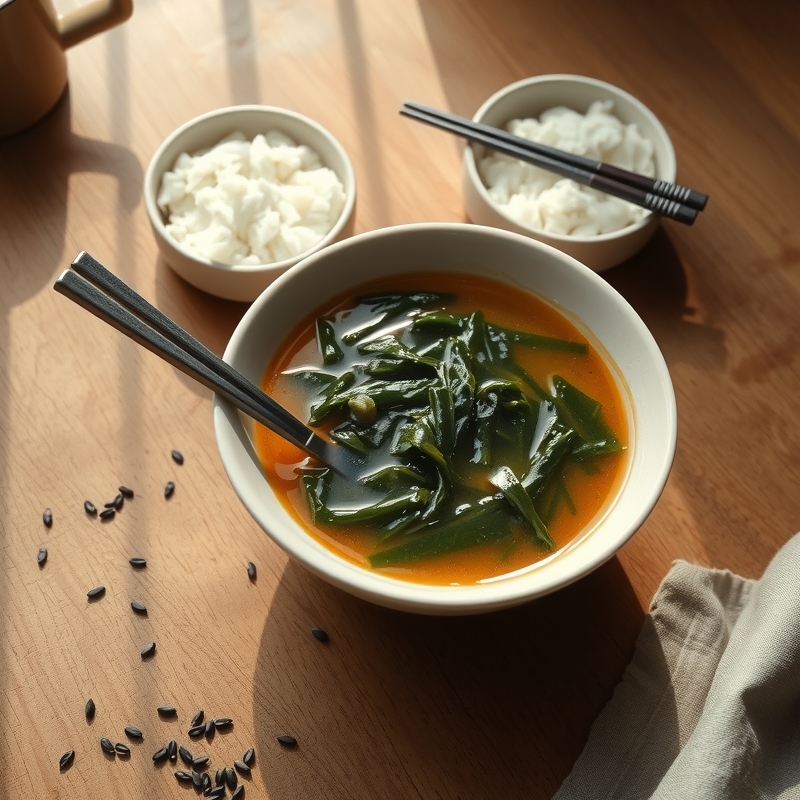
Korean men don’t take hair supplements — they eat 미역국 (miyeokguk, seaweed soup), 검은콩 (geomeun-kong, black beans), and 흑임자 (heugimja, black sesame) as part of regular meals. This is where Korean hair care diverges most sharply from the Western approach. In the West, hair loss triggers a trip to the supplement aisle. In Korea, it triggers a trip to the kitchen.
미역국 (miyeokguk, seaweed soup) is eaten on birthdays and after childbirth because seaweed is dense in iodine, iron, calcium, and omega-3 fatty acids — all directly involved in follicle health. Korean mothers serve it to the whole family, including husbands and sons, not just new mothers. It’s hair food disguised as comfort food.
검은콩 (black beans) and 흑임자 (black sesame) appear in Korean traditional medicine under the principle that “black foods nourish the kidneys and hair.” While the traditional reasoning is rooted in 한의학 (Korean traditional medicine), the nutritional science aligns: black beans provide biotin, folate, and protein; black sesame delivers zinc, iron, and essential fatty acids — all nutrients the NIH recognizes as important for hair health.
The practical version for your household: add dried seaweed to soups once a week, keep roasted black beans as a snack, and sprinkle black sesame on rice or salads. No pills, no powders, no subscription boxes.
7. The 2-Minute Nightly Scalp Massage: Korean Hair Care’s Simplest Rule
Korean men massage their scalps every night — usually while watching TV or scrolling their phones — and this one habit may matter more than any product they use. Scalp massage increases blood circulation to the follicles, which delivers more oxygen and nutrients to the hair root. It’s the same principle behind why exercise promotes hair health, concentrated directly where it matters.
The technique Korean men use is simple: place all ten fingertips on the scalp, apply medium pressure (enough to move the skin, not enough to hurt), and make small circular motions. Start at the temples, move to the crown, then down to the nape. Two minutes, no products needed.
Research published in dermatology journals has shown that consistent scalp massage can increase hair thickness by stretching the cells of hair follicles, stimulating them to produce thicker strands. The key word is consistent — this isn’t a once-a-week spa gesture. Korean men do it nightly because it takes less time than brushing teeth.
This is the rule to start with tonight. No purchase necessary, no learning curve, no product to convince him to try. Just 2 minutes of fingertip pressure on the scalp before bed. If he only does one thing from this list, make it this one.
Korean vs. Western Men’s Hair Care: Why the Approaches Produce Different Results
| Aspect | Typical Western Men’s Routine | Korean Men’s Routine | Why It Matters After 40 |
|---|---|---|---|
| Focus | Hair strands (volume, style) | Scalp health (environment for growth) | Follicle health declines with age — scalp care preserves it |
| Shampoo type | Sulfate-based, strong cleanse | 한방 herbal, gentle + nourishing | Over-stripping accelerates thinning in aging scalps |
| Post-wash care | Conditioner on ends (maybe) | Scalp tonic + cool rinse | Scalp nutrition prevents the “clean but starving” cycle |
| Exfoliation | Rarely or never | Weekly scalp scaling | Decades of buildup choke follicles silently |
| Diet connection | Supplements (if any) | Seaweed, black beans, sesame in meals | Whole-food nutrients absorb better than isolated pills |
| Daily maintenance | Nothing between washes | 2-min nightly scalp massage | Circulation decreases with age — massage counteracts this |
| Cost (monthly) | Around $5-15 (basic shampoo) | Around $15-25 (shampoo + tonic) | Small increase, dramatically better results |
Frequently Asked Questions
What happens if men skip scalp care after 40?
Without scalp care, follicles gradually weaken from sebum buildup, reduced circulation, and chronic low-grade inflammation. The result isn’t dramatic overnight hair loss — it’s the slow, steady thinning that most men blame on “genetics” when it’s often preventable scalp neglect. Starting scalp care at 40 can still improve hair density and slow further thinning within 3-6 months.
Can a Korean hair care routine actually regrow hair for men?
A Korean scalp care routine can improve thickness, reduce shedding, and create better conditions for existing follicles — but it cannot resurrect completely dead follicles. If the hair is thinning but the follicle is still alive, consistent scalp care feeds and protects it. Korean dermatologists are honest about this distinction: prevention and maintenance, not miracles.
How long does a Korean men’s hair care routine take daily?
Under 5 minutes total. The shower portion (herbal shampoo + scalp tonic + cool rinse) adds about 2 minutes to a normal shower. The nightly scalp massage is 2 minutes while watching TV. Scalp scaling adds 3 minutes once a week. This is not a 10-step K-beauty routine — it’s a handful of small, practical habits.
Is Korean hair care routine different for men vs. women?
The core philosophy — scalp first — is identical, but men’s Korean hair care tends to be more streamlined. Korean women may add hair essences, overnight masks, and heat-protectant layers. Korean men focus on the scalp essentials: clean, nourish, stimulate. The 7 rules in this guide reflect what Korean men actually do, not a simplified version of a women’s routine.
What Korean hair products should a man over 40 start with?
Start with two products: a 한방 herbal shampoo (Ryo is the most trusted Korean brand) and a scalp tonic. That’s it. Add the scalp scaler after a month if he’s consistent. Korean men don’t buy 12 products — they buy the right 2-3 and use them faithfully. The scalp massage costs nothing and should begin immediately.
Key Takeaways
- Korean men treat the scalp like a skincare routine — clean, exfoliate, nourish, and stimulate — while Western men’s grooming stops at shampoo and hopes for the best.
- Weekly scalp scaling removes invisible buildup that shampoo alone cannot dissolve, unclogging follicles that have been slowly suffocating for years.
- 한방 (hanbang) herbal shampoos are Korea’s top-selling men’s hair category because they nourish the scalp environment instead of just stripping oil.
- Post-wash scalp tonic is the missing step in every Western man’s shower — without it, every wash is a net loss for follicle nutrition.
- Korean men eat for their hair — 미역국 (seaweed soup), black beans, and black sesame deliver biotin, zinc, and iron through regular meals, not supplement bottles.
- A 2-minute nightly scalp massage costs nothing, requires no products, and is the single easiest habit to start tonight for measurable results within weeks.
Tonight, ask him to try just the 2-minute scalp massage before bed — ten fingertips, medium pressure, small circles from temples to crown. No products, no commitment, no argument. If his scalp feels different in the morning, the other six rules will sell themselves.
Ryo Hair Loss Care Gift Set (Shampoo + Scalp Tonic)
If he’s ready for rules #3 and #4 in one box — this set pairs the 한방 herbal shampoo with the scalp tonic Korean men use daily. The kind of practical gift that actually gets used instead of sitting under the bathroom sink.
(paid link) View Current Price →
This article contains affiliate links. If you purchase through these links, we may earn a small commission at no extra cost to you. We only recommend products we genuinely believe in.