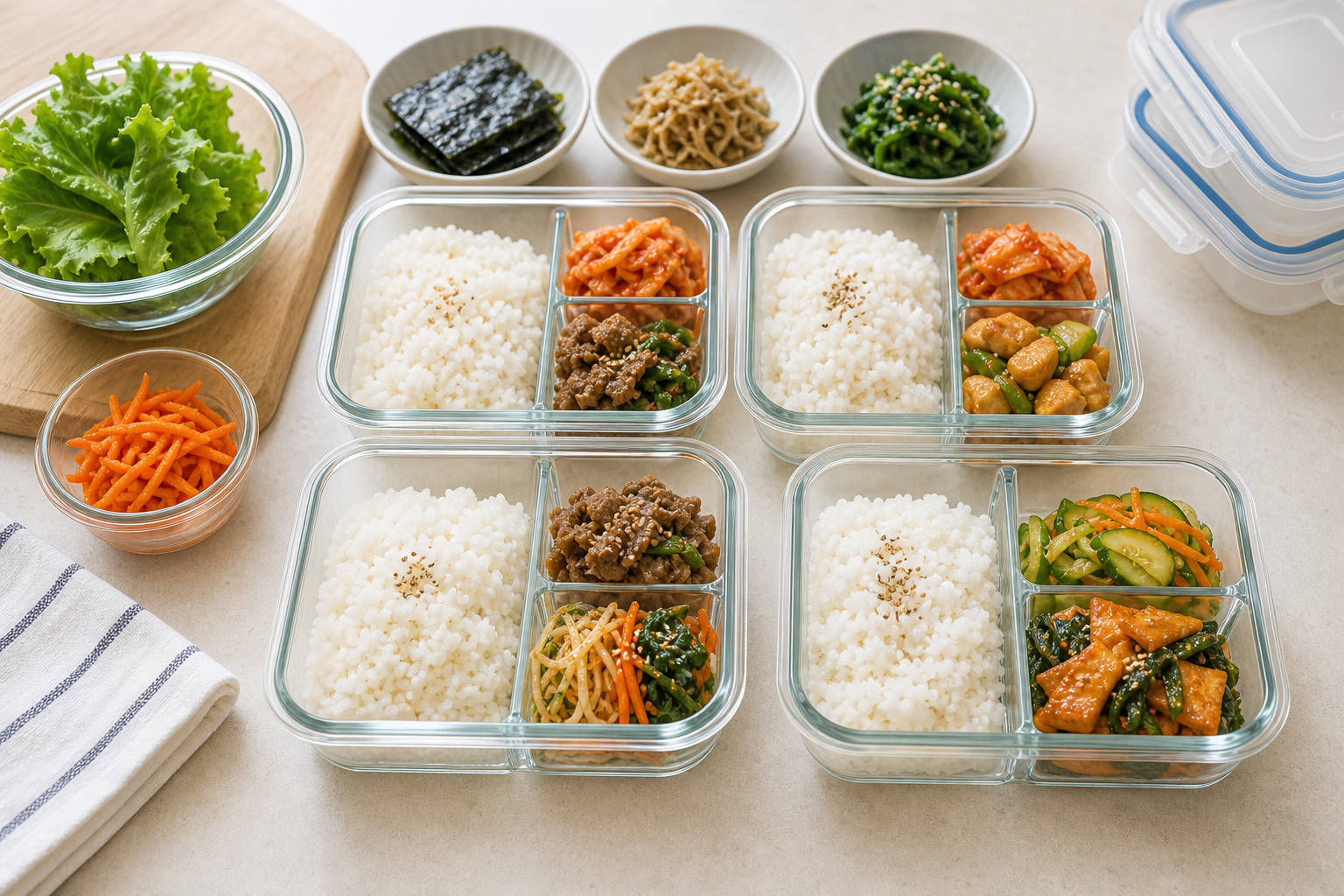
Korean households typically prepare 5-8 banchan (side dishes) in a single 90-minute Sunday session, creating a flexible meal system that covers breakfast, lunch, and dinner for the entire week. This banchan-first approach is fundamentally different from Western meal prep, which tends to portion out identical containers of one main dish. In Korea, meal prep means building a rotating library of small dishes that mix and match with a simple bowl of rice. The result is variety without burnout — and it’s a system anyone in the world can adopt.
Why Korean Meal Prep Ideas Revolve Around Banchan, Not Mains

The foundation of Korean meal prep is banchan — small side dishes that are intentionally designed for multi-day refrigerator storage. Unlike Western meal prep that centers on a protein-starch-vegetable plate, the Korean system treats rice as a constant and banchan as interchangeable modules. This means you never eat the exact same meal twice, even if you prepped everything on one day.
Most Korean refrigerators contain a dedicated banchan compartment — a feature so standard that Samsung and LG build it into every domestic model. This isn’t a marketing gimmick; it reflects how deeply batch-cooking small dishes is embedded in daily Korean life. The average Korean family keeps 3-6 active banchan containers in the fridge at any given time.
The Banchan Rotation System
Korean home cooks categorize banchan by shelf life and rotate them strategically:
- Long-life banchan (7-14 days): Kimchi, pickled radish (치킨무), soy-braised quail eggs (메추리알 장조림), dried seaweed side dishes
- Medium-life banchan (4-7 days): Seasoned spinach (시금치나물), soy-braised lotus root (연근조림), stir-fried anchovies (멸치볶음)
- Short-life banchan (2-3 days): Fresh tofu dishes, cucumber salad (오이무침), seasoned bean sprouts (숙주나물)
The strategy is to prep 2-3 long-life items every two weeks, 2-3 medium-life items weekly, and 1-2 short-life items mid-week. This layered rotation means you’re never prepping everything from scratch.
7 Korean Meal Prep Ideas for a Full Week

A practical Korean meal prep session targets 7 core items that together provide complete nutrition and endless meal combinations. Below are the specific dishes Korean home cooks prioritize, chosen for storage stability, ease of preparation, and versatility.
1. Soy-Braised Eggs (달걀장조림)
Hard-boiled eggs simmered in a soy sauce, garlic, and green chili reduction. They keep for up to 7 days refrigerated and provide quick protein at any meal. Most Korean cooks prepare 10-15 eggs per batch for a family of four.
2. Seasoned Spinach (시금치나물)
Blanched spinach dressed with sesame oil, garlic, soy sauce, and sesame seeds. This takes under 10 minutes and lasts 4-5 days in the fridge. It doubles as a bibimbap topping or a standalone side.
3. Stir-Fried Anchovies (멸치볶음)
Tiny dried anchovies sautéed with a sweet soy glaze, often with nuts or dried chili. A calcium-rich snack-side hybrid that stores for up to 10 days. Korean parents pack these in children’s lunchboxes daily.
4. Kimchi (배추김치)
While many people buy kimchi, Korean meal preppers maintain a “starter batch” of 1-2 kg that ferments through the week, developing deeper flavor. Week-old kimchi is ideal for fried rice and stew; fresh kimchi pairs best with grilled meat.
5. Seasoned Dried Radish (무말랭이무침)
Chewy, slightly sweet, and deeply savory — this rehydrated dried radish side dish stores for up to 2 weeks and is practically zero-effort. It adds texture variety that fresh vegetables can’t replicate.
6. Soy-Braised Tofu (두부조림)
Pan-fried tofu slices simmered in a spicy soy-gochugaru sauce. Best consumed within 3-4 days, making it an ideal mid-week prep item. One block of firm tofu yields 4-6 servings as a side.
7. Pre-Portioned Soup Base (국물 베이스)
Korean cooks frequently prep 2-3 liters of anchovy-kelp broth (멸치다시마육수) and store it in the fridge or freezer. This base transforms into doenjang-jjigae, kimchi-jjigae, or simple egg-drop soup in under 10 minutes on any weeknight. It eliminates the biggest time barrier to cooking Korean soups from scratch.
Korean Meal Prep Ideas Compared: Time, Cost, and Storage

Choosing which banchan to prep depends on your schedule, budget, and fridge space. The table below compares all seven items across the metrics that matter most for weekly planning.
| Banchan Item | Prep Time | Fridge Life | Cost per Batch (approx.) | Skill Level |
|---|---|---|---|---|
| Soy-Braised Eggs | 20 minutes | 7 days | $3-4 (12 eggs) | Beginner |
| Seasoned Spinach | 10 minutes | 4-5 days | $2-3 | Beginner |
| Stir-Fried Anchovies | 15 minutes | 10 days | $4-5 | Beginner |
| Kimchi (store-bought maintenance) | 0 minutes (ferments passively) | 30+ days | $5-8 per kg | None |
| Dried Radish Side | 25 minutes (includes soaking) | 14 days | $2-3 | Beginner |
| Soy-Braised Tofu | 20 minutes | 3-4 days | $2-3 | Intermediate |
| Anchovy-Kelp Broth | 25 minutes | 5 days (fridge) / 30 days (freezer) | $2-3 for 2 liters | Beginner |
Total prep time for all 7 items: approximately 90-115 minutes. Most Korean cooks tackle them in a specific order — starting with the broth (passive simmering), then eggs (passive boiling), then moving to the quick stir-fry and seasoning tasks while those simmer.
How to Assemble Korean Meal Prep Into Daily Meals
The real power of Korean meal prep is assembly, not reheating — you combine prepped banchan with a freshly cooked base to create a different meal every time. This is where the system outperforms Western meal prep’s repetitive container approach.
Weekday Assembly Examples
- Monday lunch: White rice + seasoned spinach + soy-braised eggs + kimchi = classic home-style Korean lunch in 5 minutes
- Tuesday dinner: Anchovy-kelp broth + doenjang paste + tofu + zucchini = doenjang-jjigae ready in 12 minutes
- Wednesday lunch: Rice + all banchan arranged in a bowl + gochujang + sesame oil = instant bibimbap
- Thursday dinner: Week-old kimchi + rice + egg + sesame oil = kimchi fried rice in 8 minutes
- Friday lunch: Anchovy-kelp broth + beaten egg + rice + scallion = comforting egg-drop soup with banchan sides
Notice that the base (rice or broth) is the only thing cooked fresh. Everything else comes straight from containers. Average assembly time per meal: 5-12 minutes.
The Korean Freezer Strategy
Beyond refrigerator banchan, Korean meal preppers freeze three categories of items:
- Pre-marinated proteins: Bulgogi (soy-marinated beef), dakgalbi (spicy chicken), dwaeji-bulgogi (spicy pork) — marinated raw and frozen in flat zip bags. Defrost and cook in 15 minutes.
- Soup bases: Anchovy-kelp broth, beef bone broth (사골국물), and kimchi-jjigae broth freeze for up to 30 days.
- Portioned rice: Korean families freeze individual rice portions in specialized flat containers (즉석밥 용기) immediately after cooking, preserving moisture. Microwaved frozen rice tastes 95% as good as fresh when portioned while still hot.
This three-tier system — fridge banchan, freezer proteins, freezer rice — means a complete Korean meal is never more than 15 minutes away, even on the busiest nights.
Frequently Asked Questions
How long does Korean meal prep take per week?
A full Korean banchan meal prep session takes 90-120 minutes once per week. Most Korean home cooks do one major session on Sunday and one small 20-minute refresh mid-week for short-life items like cucumber salad or fresh tofu dishes.
Can I do Korean meal prep without a rice cooker?
Yes, but a rice cooker dramatically improves consistency and convenience. Korean households universally use rice cookers with timer functions, allowing rice to be ready the moment they walk through the door. If you cook rice on the stovetop, consider batch-cooking and freezing portions in flat containers for microwave reheating.
What Korean meal prep ideas work for beginners who have never cooked Korean food?
Start with three beginner-friendly items: soy-braised eggs, seasoned spinach, and store-bought kimchi. These require minimal technique, use ingredients available at most global supermarkets, and together form a balanced Korean meal when served with rice. Add stir-fried anchovies and soup broth once you’re comfortable.
Are Korean meal prep ideas budget-friendly compared to Western meal prep?
Korean banchan-based meal prep costs approximately 30-40% less than protein-heavy Western meal prep. Banchan relies on vegetables, eggs, tofu, and dried goods — all inexpensive globally. The biggest cost factor is sesame oil and gochugaru (Korean chili flakes), but both are purchased in bulk and last months.
How do I store banchan to maximize freshness?
Use airtight glass or enamel containers, not plastic, and store each banchan separately. Korean households avoid mixing banchan in one container because flavors and moisture levels transfer. Containers with silicone-sealed lids (like those from Korean brand Lock&Lock) are the domestic standard and widely available internationally.
Key Takeaways
- Korean meal prep centers on banchan (side dishes), not single main dishes — this modular system prevents meal fatigue by enabling different combinations daily.
- A full week of Korean meals can be prepped in 90-120 minutes using the banchan rotation strategy of long-life, medium-life, and short-life items.
- Seven core banchan items — soy-braised eggs, seasoned spinach, stir-fried anchovies, kimchi, dried radish, soy-braised tofu, and anchovy-kelp broth — cover complete nutrition for the week.
- Daily meal assembly takes 5-12 minutes because only the base (rice or soup) is cooked fresh; everything else comes from prepped containers.
- Freezing marinated proteins and portioned rice extends the Korean meal prep system beyond banchan, making full dinners available in 15 minutes.
- Korean meal prep costs 30-40% less than Western protein-centric meal prep due to its reliance on vegetables, eggs, tofu, and dried ingredients.
Korean meal prep ideas are less about cooking ahead and more about building a flexible banchan system that makes every meal feel different — a philosophy that any kitchen, anywhere in the world, can put to work starting this Sunday.